
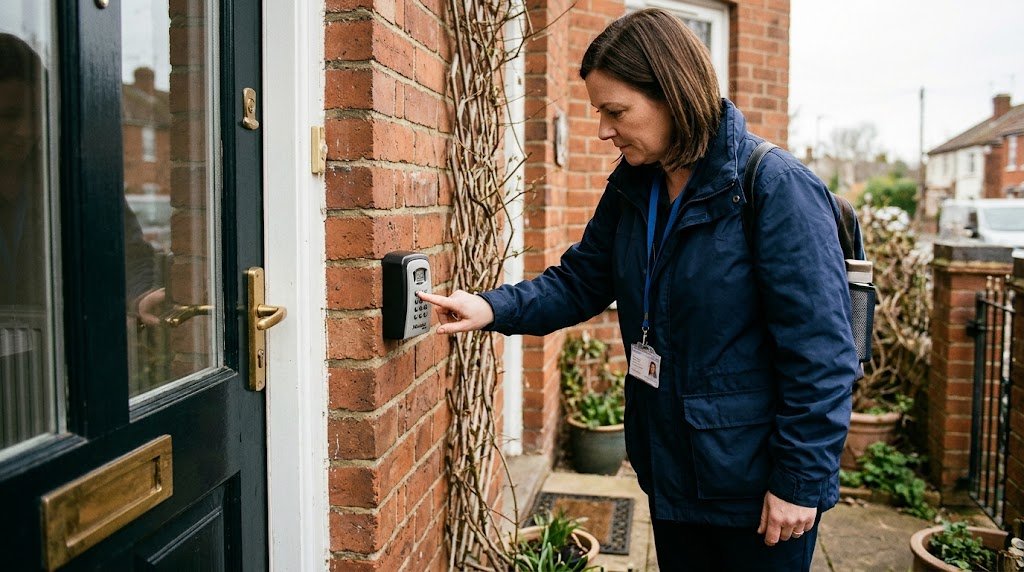
Key safes can make life much easier for older people who live alone, and for the families who worry about them. A key safe is a small locked box, fixed to an outside wall, that holds a spare front door key. With one in place, carers can let themselves in, a neighbour can check on someone who is not answering the phone, and paramedics can get in after a fall without breaking the door down.
Good Sense Guide may earn a small commission if you buy through links on this page, at no extra cost to you. This does not affect our recommendations.
This guide explains what to look for, suggests five models and shows you how to set one up safely.
Who key safes suit
A key safe is worth thinking about if any of these apply:
- Carers or a cleaner visit at set times.
- The person wears a personal alarm or pendant.
- Getting to the door or using the stairs is difficult.
- Family live far away and want a trusted neighbour to be able to call in.
- The person often locks themselves out.
If you rent or live in a flat, check with your landlord, housing association or management company first. Many will agree, but some ask for a particular type.
Why police approved key safes matter
Cheap key safes can be forced open with a hammer or crowbar. So a stronger model is worth the extra cost, because it protects the key to the whole home.
Look for these marks on the box or in the listing:
- Secured by Design. This police backed scheme means the product meets the Police Preferred Specification.
- LPS 1175. This is an independent test of how well the box resists attack.
- Sold Secure. This is another independent test, which rates key safes at levels such as Silver.
Shops often call these models “police approved”. However, insurers vary, and some may refuse a claim if a burglar used a key from a key safe. So call your home insurer before you fit one, even a police approved model.
Five key safes for older people worth considering
Prices are rough and change often. Basic key safes cost roughly £20 to £40, while police approved ones cost roughly £60 to £120.
Supra C500 Pro
Councils, care agencies and alarm providers use the Supra C500 Pro more than any other key safe. It is police approved and has passed LPS 1175 testing. It also has a large push button keypad, a weather cover and room for several keys.
Best for: anyone with carers or a personal alarm who wants the most trusted option.
Roughly: £60 to £80.
Search for the Supra C500 Pro on Amazon
Burton Keyguard Digital XL
This is another police approved model with a push button code. It makes a good alternative to the Supra C500 Pro if that is out of stock, or if you prefer the look of it.
Best for: families who want a police approved model from a second well known brand.
Roughly: from around £60.
Search for the Burton Keyguard Digital XL on Amazon
Master Lock 5426 (Sold Secure and Secured by Design)
The Master Lock 5426 has a Sold Secure Silver rating and the Secured by Design mark. It has a 14 button keypad and a solid zinc body. In addition, its extra large space can hold car keys as well as house keys.
Best for: people who need to store more than one or two keys.
Roughly: £70 to £90.
Search for the Master Lock 5426 on Amazon
Yale Y500
The Yale Y500 is not police approved, so it is less strong than the first three. It uses four number dials rather than buttons. Usefully, it will not close while the code is showing, which reminds you to scramble the dials.
Best for: a lower risk spot, such as inside a locked side gate, or as a stopgap.
Roughly: around £30.
Search for the Yale Y500 on Amazon
Master Lock Select Access 5401
This is the cheapest option here, and it is not police approved. A sliding cover keeps dirt and rain off the dials.
Best for: occasional use, such as letting in a cleaner, where security matters less.
Roughly: around £25.
Search for the Master Lock 5401 on Amazon

How to set up key safes safely
- Pick a sensible spot. Choose an outside wall, ideally not right beside the front door and out of view from the street. Then tell trusted visitors where it is.
- Fix it to solid brick or concrete. Use the fixings in the box and follow the instructions exactly. A thief could pull a box off soft render or a fence panel.
- Choose a good code. Use five to seven different numbers. Avoid 1234, the house number or a birth year.
- Share the code carefully. Only give it to trusted people, such as family, a neighbour, the care agency and the alarm provider. Also keep a note of who knows it.
- Change the code regularly. For example, change it when a carer leaves, after a hospital stay or every few months.
- Always close it properly. Never leave it open, and scramble the dials or clear the keypad after use.
- Tell the alarm provider. Give the monitoring team the code and the location, so they can pass it to the ambulance service. If the alarm runs through the landline, see our guide to the digital landline switch and telecare alarms.
Getting help fitting key safes for older people
Fitting usually takes under an hour for someone handy with a drill. Otherwise, try one of these:
- Age UK handyperson services. Many local branches offer low cost help for people over 60. Find your local Age UK.
- Your council or care provider. Some councils and care agencies fit key safes, sometimes for free, especially for people with carers or a council alarm. Ask your local adult social care team. Find your local council on GOV.UK.
- Your alarm provider. Many personal alarm companies sell and fit key safes, often a Supra C500 Pro.
- A locksmith or handyperson. Expect roughly £40 to £80 for fitting only, or £60 to £150 to supply and fit. Prices are higher in London and the South East, so use a trusted trader scheme. Find a TrustMark registered tradesperson.
Before you buy key safes
- Check whether your landlord or housing provider needs a particular model.
- Ask your home insurer whether they accept a key safe, and whether they want a police approved one.
- Ask the care agency or alarm provider if they already supply one, so you do not pay twice.
- Measure the keys, because some key safes only hold two or three standard keys.
- Look for the Secured by Design or Sold Secure mark in the listing, not just the word “secure”.
Final thoughts on key safes
A key safe is a simple, low cost way to make living alone feel safer. It lets help reach someone quickly, and it eases the family’s worry. For most people with carers or a personal alarm, a police approved model such as the Supra C500 Pro is the sensible choice.
Whichever you choose, fit it somewhere discreet, use a strong code and share it only with people you trust. For more ways to feel safe at the door, see our guide to video doorbells.