
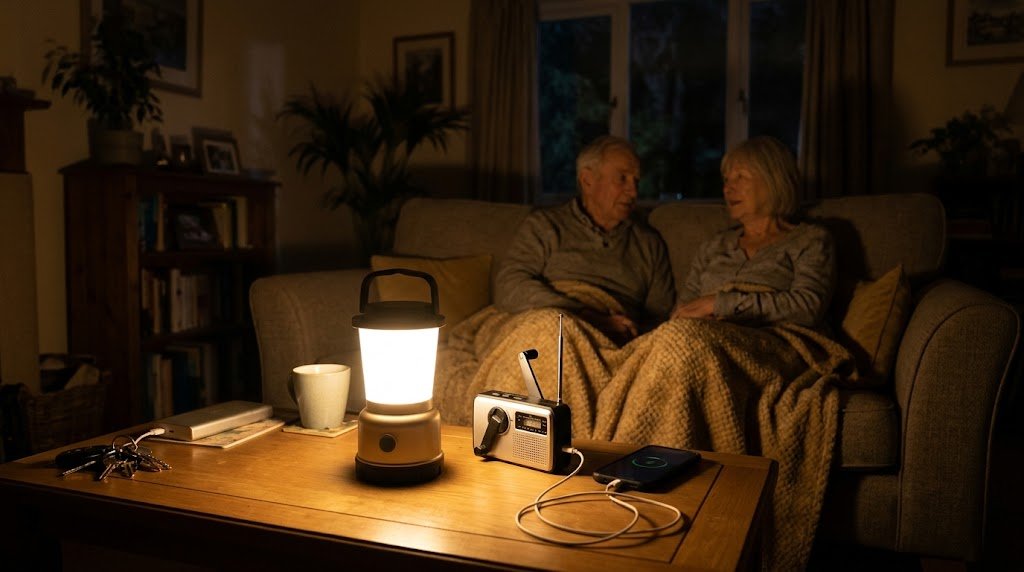
A power cut can be worrying, especially in winter or for people who live alone. The lights go out, the heating may stop and the phone may not work. However, a little preparation makes a big difference. In fact, it only takes a few simple items to be ready for a power cut.
In this guide, we explain what to keep at home, which gadgets are worth buying and who to call for help.
Why it pays to prepare for a power cut
Most power cuts are short, but storms can sometimes leave homes without power for a day or more. In the dark, it is easy to trip or fall. In addition, many homes now have digital phone lines that stop working during a power cut. Our guide to the digital landline switch explains why, and what it means for telecare alarms.
Who to call in a power cut
Call 105. This free number puts you through to your local electricity network in England, Scotland and Wales. You can report a power cut or get an update. The Power Cut 105 website explains more.
Join the Priority Services Register. This is a free service from energy suppliers and network operators. It is for people who may need extra help, such as older people or those who rely on medical equipment. Once registered, you may get warnings before planned power cuts and extra support during one. To sign up, contact your energy supplier. Ofgem, the energy regulator, also has details.
The power cut kit worth having
LED torches and lanterns
Keep a torch beside the bed and another in the kitchen. LED torches are bright and the batteries last a long time. A lantern lights up a whole room, so it is safer than carrying a torch around. Rechargeable models are good, as long as you keep them charged.
Emergency lights for a power cut
Some plug in night lights turn into torches during a power cut. They light up the moment the power goes, which is very helpful in the middle of the night. Our guide to motion sensor night lights explains more about lighting your route at night.
Power banks
A power bank is a portable battery that charges your mobile phone. When the lights go out, your mobile may be your only way to call for help. Choose one with enough capacity to charge your phone several times, and keep it charged. Check it every few months too.
Battery or wind up radios
A radio keeps you in touch with local news and updates. Wind up radios need no batteries at all. Some also have a built in torch and can charge a phone in an emergency.
Keeping warm
Have warm layers, blankets and a hot water bottle ready. If you know a power cut is coming, fill a flask with a hot drink. Our guide to gadgets to help older people keep warm has more ideas.
A simple power cut checklist
Keep a torch and spare batteries within easy reach, along with a charged power bank and a radio. It also helps to have a list of important phone numbers on paper, plus warm clothes and blankets. Finally, a key safe lets family or carers get in to check on you.
Avoid candles if you can, because they are a fire risk, especially in the dark.
Where to buy power cut kit
View LED torches and lanterns on Amazon
View emergency plug in lights on Amazon
Frequently asked questions
Who do I call in a power cut?
Call 105 for free from a landline or mobile. Your electricity network will tell you what is happening.
Will my landline work in a power cut?
If your phone now runs over broadband, it will usually stop working when the power goes off. So, keep a charged mobile phone and power bank as a backup.
How big a power bank do I need?
A 10,000 to 20,000 mAh power bank will charge most phones two to four times.
The bottom line
It is easy and cheap to be ready for a power cut. Keep a torch, a power bank and a radio to hand, join the Priority Services Register, and remember the number 105. In short, a few simple items bring real peace of mind this winter.
Good Sense Guide may earn a small commission if you buy through links on this page, at no extra cost to you. This helps us keep the site running.