

Magnifiers for poor eyesight can make a real difference to everyday life. For example, reading post, checking medicine labels or looking at a menu becomes much easier. In addition, the right magnifier helps people stay independent for longer.
In this guide, we explain the main types of magnifier, who each one suits and what to look for before you buy.
Why magnifiers for poor eyesight help
Many of us find small print harder to read as we get older. Glasses help, but they do not always go far enough. For example, conditions such as macular degeneration can make print look blurred even with the right glasses.
Magnifiers for poor eyesight make text and pictures bigger, so the eye has less work to do. Many also have a built in light, which helps a great deal. In fact, good light is often as important as magnification.
Always have your eyes tested first. An optician can check for health problems and tell you how much magnification is likely to help. The RNIB also offers free advice on living with sight loss.
Types of magnifiers for poor eyesight
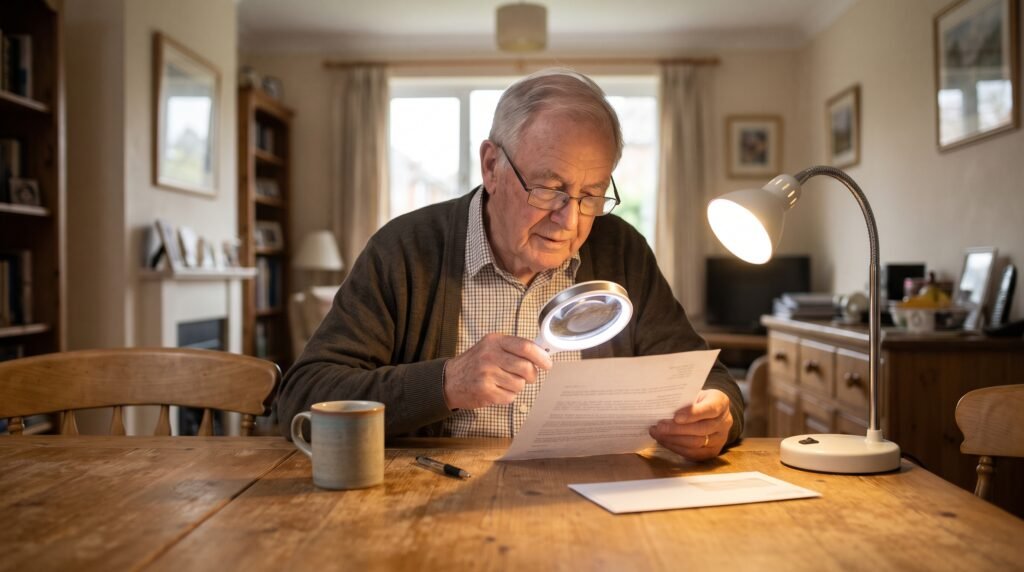
Handheld magnifiers
These are the simplest and cheapest magnifiers for poor eyesight. You hold the lens over the page and move it until the text is clear. Choose one with an LED light for reading in dim rooms. As a result, they are ideal for quick jobs such as reading a price tag or a bus timetable.
Stand magnifiers
A stand magnifier rests on the page, so you do not need to hold it steady. As a result, they suit people with shaky hands or arthritis. They are also good for reading longer letters or books at a table.
Full page magnifiers
These are flat sheets that cover a whole page. They give only a small boost. However, they let you see a full page at once, so they work well for recipes, newspapers and puzzle books.
Digital magnifiers
A digital magnifier uses a small camera and a screen. You place it over the text and it shows a much bigger picture. Many let you change the colours too, such as white text on black, which some people find easier to read. Some can even freeze the image, so you can read a label on a high shelf up close.
They cost more than a glass magnifier. However, they give far more magnification and are the best magnifiers for poor eyesight when sight loss is serious.
Reading lamps
A daylight reading lamp gives bright, clear light that is close to natural daylight. Some models also have a magnifier built into the lamp head. Therefore, this is a good choice for crafts, sewing and hobbies.
What to look for in magnifiers for poor eyesight
Magnification strength. This is shown as a number such as 3x or 5x. Higher numbers make things bigger, but you see less of the page at once. So, start low unless your optician advises otherwise.
A built in light. LED lights are bright and the batteries last a long time.
Comfort. Choose a magnifier with a handle that is easy to grip.
Batteries or charging. Rechargeable models save money over time. On the other hand, battery models are simpler for some people.
Screen size. For digital magnifiers, a bigger screen shows more words at once.
Do not forget your phone or tablet
Most smartphones have a free magnifier built in, so they can work alongside magnifiers for poor eyesight. On an iPhone, search for Magnifier in the settings. On Android phones, the camera can zoom in on text. You can also make the text on your screen bigger. Our guide to setting up a phone or tablet explains how.
Similarly, an e reader is a good option for book lovers, because you can make the text as large as you like. See our guide to the best e readers for older readers.
Where to buy magnifiers for poor eyesight
We have set up searches to help you get started.
View LED handheld magnifiers on Amazon
View digital magnifiers on Amazon
View daylight reading lamps on Amazon
View digital magnifiers on eBay
Frequently asked questions
What strength magnifier do I need?
For small print, 3x to 5x suits most people. For more serious sight loss, however, you may need a stronger or digital magnifier. Your optician can advise you.
Are digital magnifiers worth the money?
Yes, if you have significant sight loss. That is because they give much more magnification and better contrast than glass.
Can I get help paying for magnifiers for poor eyesight?
Some low vision services lend or supply magnifiers. So, ask your optician or GP about a referral to your local low vision clinic.
The bottom line
Magnifiers for poor eyesight range from simple handheld lenses to clever digital readers. First, have an eye test. Then choose a magnifier with a good light that feels comfortable to use. In short, the right one can make reading a pleasure again.
Good Sense Guide may earn a small commission if you buy through links on this page, at no extra cost to you. This helps us keep the site running.