
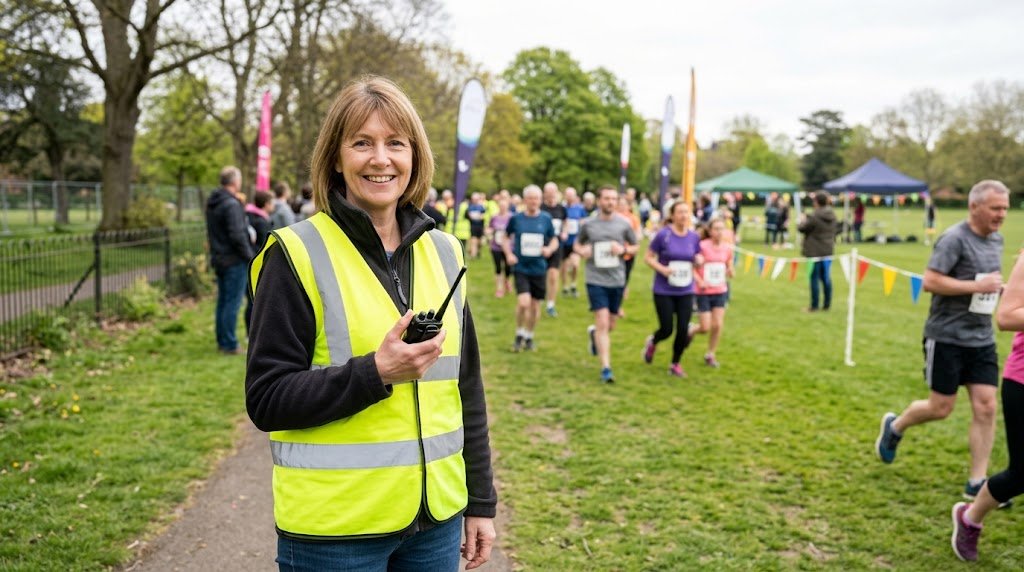
Walkie talkies for charity volunteers keep your team in touch at events, without relying on mobile signal or running up phone bills. Whether you are marshalling a sponsored walk, running a car park or managing a busy fete, radios make everything smoother and safer.
In this guide, we explain which walkie talkies to buy, what the range really means and how to set up a simple system your volunteers will find easy.
Why use walkie talkies instead of phones?
Mobile phones are great, but they have limits at events. Signal can be poor in parks, fields and large buildings. Calling one person at a time is also slow, whereas with a radio, everyone on the channel hears the message at once.
In addition, volunteers do not need to share their personal phone numbers. There are no call charges and no fiddly screens either. As a result, walkie talkies are faster, cheaper and better for safety when something goes wrong.

Licence free walkie talkies in the UK
In the UK, you can use PMR446 walkie talkies without a licence. These are the type sold in most shops and online. Make sure any radio you buy says PMR446 and is meant for UK or European use. Some imported radios use other frequencies and are not legal to use here without a licence. Ofcom, the UK communications regulator, sets these rules.
What range can you expect from walkie talkies?
Boxes often claim a range of 10 kilometres or more. In real life, however, this only happens on a clear day across open water or hilltops. Trees, buildings and hills cut the range a great deal.
As a rough guide, expect a few hundred metres in a town and up to a couple of kilometres across open ground. That is enough for most charity events. For very large sites, place a volunteer with a radio at a high point to pass messages on.
What to look for in walkie talkies
Rechargeable batteries. A charging dock that holds several radios keeps things tidy. Check the battery lasts a full day.
Packs of four or six. Buying in a set is cheaper and makes sure all radios work together.
Earpieces. These keep messages private and help in noisy places. Many packs include them.
Belt clips. Volunteers need their hands free.
Simple controls. Choose radios with a clear push to talk button and few menus.
Weather resistance. Useful for outdoor events in the British weather.
Setting up walkie talkies for your event
First, choose one channel for the whole team, and a second channel for first aid or emergencies. Next, give each volunteer a short call name, such as Gate One or Car Park. Then run a quick test at the start of the day.
It also helps to teach the basics. Press the button, wait a second, then speak. Keep messages short, and say “over” when you finish.
Finally, number each radio and keep a sign out sheet, so all radios come back at the end. Remember to charge everything the night before.
Lend, borrow or share
Walkie talkies last for years. Therefore, it is worth sharing a set with other local groups, or lending yours out. If you also need to be heard by a crowd, see our guide to portable PA systems for charity events. For other ways to get kit cheaply, read how small charities can get free or discounted technology.
Where to buy walkie talkies
View PMR446 walkie talkie packs on Amazon
View walkie talkies with charging docks on Amazon
View used walkie talkie sets on eBay
Frequently asked questions
Do we need a licence for walkie talkies?
Not for PMR446 radios. These are licence free in the UK.
Can different brands of walkie talkies talk to each other?
Usually, yes, if they are all PMR446 and set to the same channel and code. However, buying one set is simpler.
How many radios do we need?
Plan for one for each key role, such as the organiser, first aid, car park and each marshal point, plus one spare.
The bottom line
Walkie talkies for charity volunteers are a small investment that makes events safer and easier to run. Choose licence free PMR446 radios, buy a matching set with rechargeable batteries, and keep the system simple. In short, a good set will serve your charity for years.