

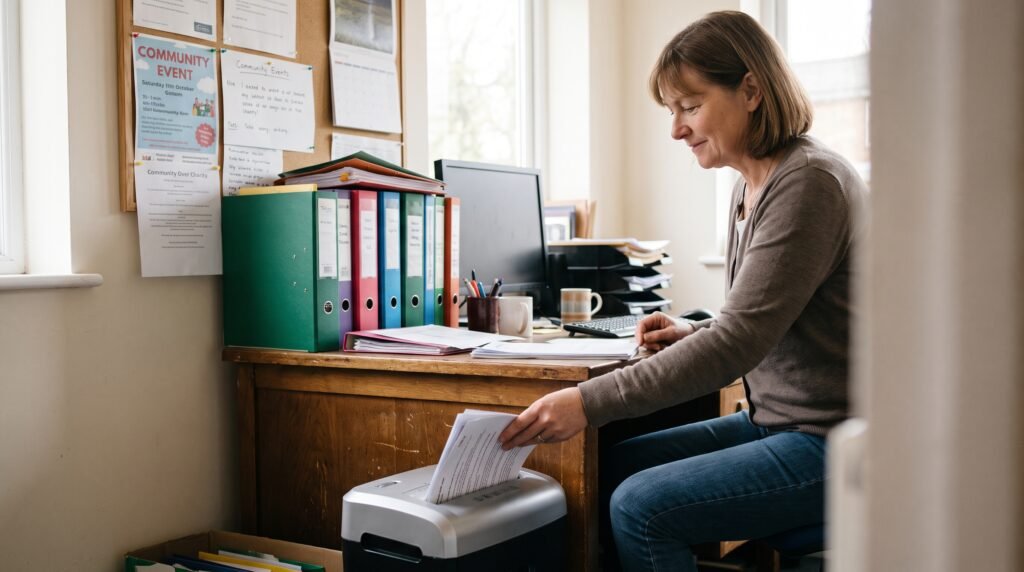
Paper shredders for small charities are one of the cheapest ways to protect the people you support. Most charities still hold some paper records, from sign up forms to Gift Aid declarations and case notes. So, when you no longer need them, you must get rid of them safely.
In this guide, we explain why shredding matters, which paper shredders to buy and how to set up a simple routine.
Why paper shredders matter
UK data protection law says you must keep personal data secure, including when you throw it away. A sheet of paper in a recycling bin can easily be read by someone else. As a result, a data breach can harm the people you work with and damage trust in your charity.
The Information Commissioner’s Office (ICO) has free guidance for small organisations. It is well worth reading, especially if you hold sensitive information such as health details.
Security levels for paper shredders
Paper shredders are graded by a security level from P1 to P7. The higher the number, the smaller the pieces.
P2 strip cut. Paper is cut into long strips. These can be pieced back together, so this level is not suitable for personal data.
P3 cross cut. This level cuts paper into small pieces and suits general office paper.
P4 cross cut. Here the pieces are smaller again. This is a sensible minimum for most personal data, such as names, addresses and bank details.
P5 micro cut. Tiny pieces make this a good choice for highly sensitive records, such as health or safeguarding notes.
For most small charities, therefore, a P4 cross cut shredder is the right balance of security and price.
What else to look for in paper shredders
Sheet capacity. This is how many sheets the shredder can take at once. Eight to twelve sheets suits a small office.
Run time. Cheap shredders often need to rest after a few minutes. If you have a big clear out, however, choose one with a longer run time.
Auto feed. Some models let you load a stack of up to 100 sheets and walk away. This saves volunteers a lot of time.
Bin size. A bigger bin means emptying it less often.
Staples and cards. Many paper shredders can also handle staples, credit cards and even CDs.
Safety. Look for an auto stop when the bin is opened, and keep the shredder away from children.
Using paper shredders: a simple routine
First, decide how long you keep each type of record, and write it down. This is called a retention policy. Next, keep a locked tray or box for paper waiting to be shredded. It is also better to shred little and often, rather than letting piles build up.
For a big clear out, think about a professional shredding service instead. They will give you a certificate of destruction.
Shredding is only one part of the picture. Our guide to keeping your small charity safe online covers digital records too. For more ways to save money on supplies, see our guide to cheap office supplies for charities.
Where to buy paper shredders
View P4 cross cut shredders on Amazon
View auto feed shredders on Amazon
View micro cut P5 shredders on Amazon
View cross cut shredders on eBay
View auto feed shredders on eBay
Frequently asked questions
What security level does a charity need?
P4 cross cut is a sensible minimum for personal data. For very sensitive records, choose P5.
Can we recycle shredded paper?
Often, yes. However, some councils do not accept shredded paper in recycling bins, so check locally. It can also be used for composting or animal bedding.
Are cheap paper shredders good enough?
For a few sheets a week, yes. For regular use, though, a sturdier model with a longer run time will last much longer.
The bottom line
Paper shredders for small charities are a small cost that protects the people you serve. Choose at least a P4 cross cut model, set up a simple routine and keep paper secure until it is shredded. In short, good habits with paper build trust in your charity.