

Pill dispensers and medication reminders help people take the right tablets at the right time. This matters more as we get older, because many people take several medicines a day. In fact, it is easy to forget a dose, or to take one twice by mistake.
In this guide, we explain the main types of pill dispensers, from simple weekly boxes to dispensers that sound an alarm. We also cover how families can help from a distance.
This guide is general information only. Always follow the advice of your GP or pharmacist about your own medicines. Good Sense Guide may earn a small commission if you buy through links on this page, at no extra cost to you.
Why pill dispensers help
Missing medicines can make health conditions harder to control. Taking a dose twice can be just as risky. For example, some tablets must be taken at fixed times, or with food.
Pill dispensers take the guesswork out of it. As a result, people feel more confident, and families worry less. The NHS medicines guide also explains how to take common medicines safely.
Types of pill dispensers and medication reminders
Weekly pill organisers
The simplest option is a plastic box with a compartment for each day. Many have up to four sections a day, for morning, lunch, evening and bedtime. These basic pill dispensers are cheap and work well for people who remember easily but like a clear system.
Look for large lids that are easy to open, especially if you have arthritis. Some also have big, bold letters for people with poor eyesight.
Organisers with alarms
Some pill boxes come with a small built in alarm, or a separate timer that beeps at set times. Therefore, they are a step up for people who forget to check the box.
Automatic pill dispensers
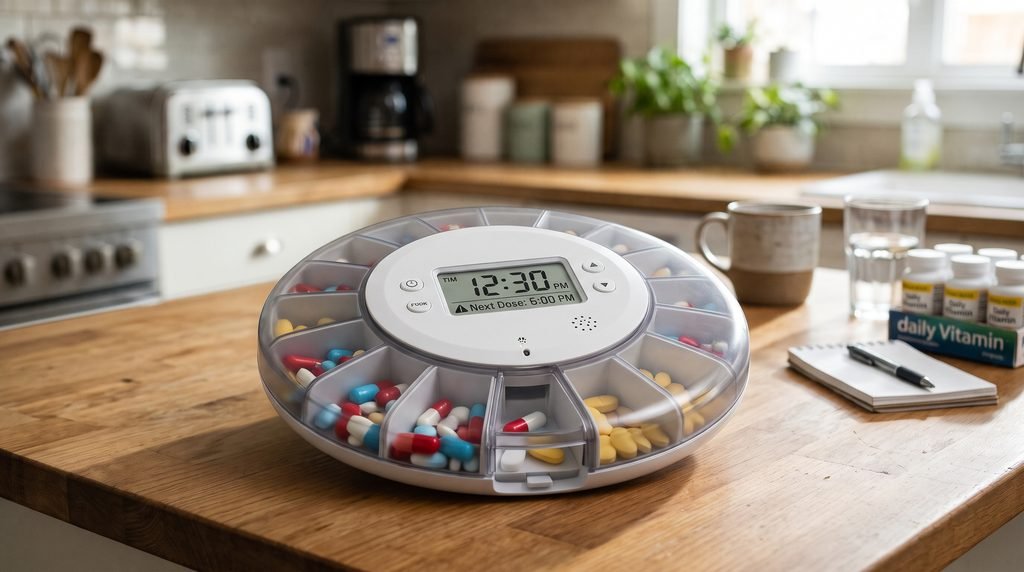
Automatic pill dispensers are locked carousels that you or a family member fill in advance. At each set time, the dispenser beeps or flashes and opens only the right compartment. Meanwhile, the rest stay locked.
This prevents someone from taking the wrong dose by mistake. For this reason, automatic dispensers suit people living with memory loss. Some models can even alert a family member by text if a dose is not taken. Pivotell is one well known UK brand.
Phone apps and smart speakers
A smartphone can set daily alarms with a message, such as “Take your blue tablet with breakfast”. Free apps can track doses too. Similarly, a smart speaker can give spoken reminders. Our guide to smart speakers and health gadgets explains how.
Other things that help alongside pill dispensers
A day clock. If someone loses track of the day, a clear clock helps a great deal. See our guide to day clocks for memory loss.
Ask the pharmacy. Some pharmacies can supply medicines in sealed packs sorted by day and time, sometimes called blister packs. So, ask your pharmacist whether this is suitable and available.
A written list. Keep an up to date list of all medicines in a purse or wallet, and on the fridge. It helps in an emergency.
A medicines review. Ask your GP or pharmacist to review your medicines from time to time. Sometimes the routine can be made simpler.
What to look for in pill dispensers
- Enough compartments. Count how many times a day medicines are taken, and choose a box with at least that many sections.
- Lids that are easy to open. Push button or sliding lids suit stiff fingers better than small snap lids.
- Clear labels. Large letters, or colours for each time of day, make mistakes less likely.
- A loud alarm or flashing light, if the person has hearing loss or often forgets.
- A lock, if there is any risk of taking the wrong dose. Locked automatic dispensers are the safest choice for memory loss.
- Batteries and backup. Check how long the batteries last and whether the dispenser warns you when they run low.
Some sellers of automatic pill dispensers offer VAT relief if the person has a long term illness or disability. It is worth asking before you buy.
Where to buy pill dispensers
Weekly organisers cost just a few pounds, while alarm boxes and automatic dispensers cost more. Prices change often, so compare a few sellers before you buy.
See weekly pill organisers on Amazon | See them on eBay
See pill boxes with alarms on Amazon | See them on eBay
See automatic pill dispensers on Amazon | See them on eBay
How families can help from a distance
If you live some distance away, you can still help. First, fill the dispenser on a weekly visit, or ask a carer or neighbour to do it. Next, choose a model that sends a text alert if a dose is missed, so you know straight away.
A short daily phone or video call at medicine time can also help, and many people enjoy the chat. Our guide to the best tablets for video calls with family explains the simplest options. In addition, a key safe lets carers get in to help if needed.
Pill dispensers: the bottom line
In short, the right pill dispensers depend on how much help someone needs. A weekly organiser suits people who just like a clear system. An alarm box helps those who forget to check. For anyone living with memory loss, a locked automatic dispenser is the safest choice. Whichever you choose, talk to your pharmacist first, and set it up together so it feels familiar from day one.